Bob White was a coach, a mentor, a guide, and some would say an oracle. Through his organization, the Westend Sports Association, White mentored and guided thousands of young Black men. He shepherd some into the ranks of professional sports.
Bob White and I never had coffee together, but our paths crossed more than once over the decades. In the 80s, I learned of his work with young Black athletes, and like many in the community, I eagerly read his columns and features in the local Black newspaper. His articles were just as scrappy and raw as his conversations in person. I admired his no-nonsense stories. He did not glamorize being a Black man in Montréal. Though I interviewed him for my book, and I did recount it verbatim, my books were never strong enough, nor forceful enough to satisfy his need for the unvarnished truth.
That was why I was surprised when, every now and then, I would find packages or envelopes from Bob White and/or the Westend Sports Association on my front porch. Like other materials I’ve received unsolicited, I kept them, thinking that maybe there was an interest in preserving his work. That did not happen before Bob White’s death in 2016. Nonetheless, I will hold on to the few packets housed in Sankofa Archives and Collections if only to continue to give Bob’s authentic voice a permanent space. Thanks to Sankofa’s massive newspaper collection, we can access his articles on all-things-community. Further, by visiting his tribute page online at Community Contact, https://mtlcommunitycontact.com/bob-white-1935-2016/, we can learn about Bob’s legacy and his impact on people’s lives. Feel free to immerse yourself in his work, but grab a coffee beforehand.
FEATURE OF THE MONTH: RAVEN GRIFFIN
By Raven Griffin
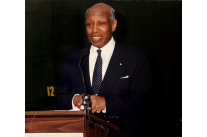
Treasure of the Month: Richard Lord is seated on the table second from left, between his older twin brothers Frederick Levi Lord and Reginald Samuel Lord. The eldest, James Robert Lord, is on the far right. This photo was taken circa early 1930s, before his younger sisters Dora Louise Lord and Gwendolyn Valerie Lord were born. Their father, James Levi Theophilus Lord, supported the family working as a railroad porter for CPR. Richard Lord would go on to contribute to events honouring black railroad porters, including an event in February 1999 when he spoke at the installation of a plaque for railroad porters in Windsor Station, Montreal. (Left picture)
FOI-19-192 (family photo) and FOI-19-139 (Windsor Station speech)
I heard about the Archive through the list of practicum opportunities that were open for students in the McGill School of Information Studies. It caught my interest for a couple of reasons. I have a background in Canadian history and have always been interested in learning about communities and narratives that are excluded from the usual subject matter of Canadian history lessons. I also love working with photographs, so I was excited by the prospect of working with Richard Lord’s photography collection to understand more about his life and work.
I began in January and have been working to generate metadata records for photographs in the archive. This involves making note of key people, places, and things in each photograph, as well as recording any additional context for the image found through archival research. I’ve also been rehousing photographs in archival enclosures for better preservation. Photography archivist, Kelann Currie-Williams, has been a big help in guiding my work and making sure that I have the appropriate supplies at every step.
Pictures really are worth a thousand words, and I think that anyone interested in Richard Lord’s life would be interested in seeing the photography collection. Lord attracted attention whether he was speaking at formal events or playing hockey on an otherwise all-white high school team. Seeing these images really showed me how confident and self-assured he was. This collection will definitely be an important resource for any potential exhibits or biographical researchers to illustrate his life.